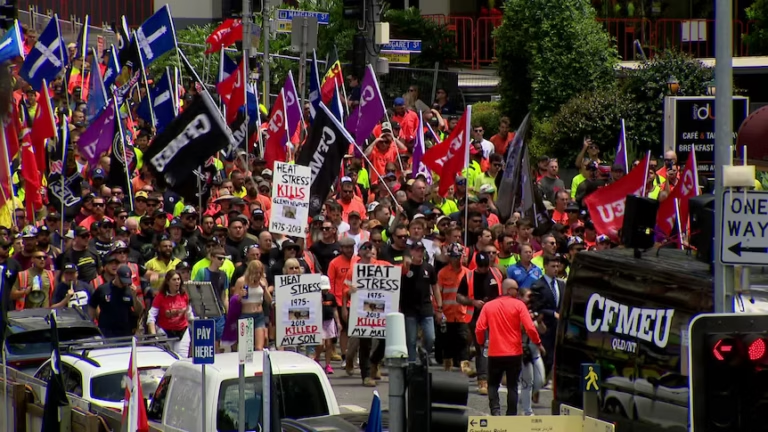
Red & Black Notes || The Albanese Labor government has done a deal with the Liberals to pass legislation aimed at destroying the CFMEU. Make no mistake, the government’s CFMEU Act is a plan to kill a union.
The strongest argument against this law is this: take a look at what is in it. The following is a summary of everything in the government’s CFMEU legislation1.
When will administration take effect?
The bill puts the Construction and General Division and all of its branches into administration. This includes WA and the ACT.
The administration takes effect as soon as the Minister (Senator Murray Watt) issues a scheme of administration (essentially rules for the administration) and an administrator is appointed.
This could happen within a day of the bill passing.
Rules for administration?
The bill gives the Minister the power to issue a legislative instrument establishing the rules for the administration (called the scheme of administration).
Normally the Senate can pass a motion to disallow a legislative instrument. This bill prevents the operation of section 42 of the Legislation Act 2003 (disallowance motions).
The bill requires that administration last for at least three years.
The bill states that a scheme has to provide for
- The suspension or removal of officers (sacking organisers etc)
- Declarations that offices are vacant (sacking elected officials)
- The timing of elections of officers
- Disciplinary actions by the administrator
- The termination of CFMEU employees
- Altering the rules of the CFMEU
- Employing people to assist the administrator, and delegating powers to them
The scheme rules will give the administrator the power to expel members and disqualify union officers for up to five years. This includes “circumstances not provided for by the rules of the CFMEU”.
The bill states that the Minister does not have to have regard for the rules of natural justice.
Powers of the administrator
Whilst the Construction and General Division is under administration, the administrator controls everything as if they were the union.
The bill makes clear the administrator can manage and dispose of property, spend money, and perform any power or function that any official, branch, or division could before the administration.
The administrator is also tasked with “promoting compliance … with the laws of the Commonwealth, the States, and the Territories”. The administrator is required to ensure officers and employees have complied with the law and continue to do so, including before this law was passed. This includes all workplace laws, including during the ABCC era.
Wherever officers and employees of the union haven’t complied with the law, now or in the past, the administrator is required to “ensure they are held accountable for having not done so”. No part of the bill restricts the administrator in instances where fines have already been issued and paid.
In order to ensure the administrator doesn’t run wild, the administrator has to be satisfied that the administrator is acting in the interests of members.
People sacked or suspended are effectively banned for life
The bill creates a category within the Fair Work Act 2009 called a “removed person”.
A “removed person” is any official, employee, or union delegate who is sacked, removed from their position, suspended, or who’s position “otherwise comes to an end” during an administration.
This can also include anyone who resigned from their position after 1 July 2024 if an administrator decides.
The bill prevents “removed persons” from ever acting as a bargaining representative, unless they get permission from the Fair Work Commission.
This means that employees, officials, and delegates removed by the administrator (or resigning after 1 July 2024) cannot represent workers in enterprise bargaining negotiations, anywhere, and potentially for life.
The bill prevents “removed persons” from running for any union office, being appointed to any union office, or working for any union, unless they get permission from the Fair Work Commission.
This means that employees, officials, and delegates removed by the administrator (or resigning after 1 July 2024) cannot work for a union, run for union office, be elected to union office, or be appointed to union office, anywhere, and potentially for life.
The bill creates fines of 600 penalty units ($187,800) for any “removed person” who becomes an employee or official of a union without permission.
Law and CFMEU rules do not apply
The bill states that the scheme of administration has effect despite anything in the rest of the Fair Work (Registered Organisations) Act 2009 or the CFMEU rules.
This also applies to actions taken by the administrator.
The bill goes further and says that the actions of the administrator remain in effect even after the administration ends, again, irrespective of any CFMEU rule or the rest of the Fair Work (Registered Organisations) Act 2009.
Changing CFMEU rules
The bill gives the administrator the power to change the rules of the Construction and General Division.
There is no requirement that the members approve rule changes. The normal processes for changing union rules do not apply.
Powers to compel
The bill gives the administrator the power to compel people to provide information, surrender documents, and “provide assistance”.
The administrator has the power to compel officials and staff, former officials and staff, and people who had done work for the Construction and General Division in pretty much any capacity.
Anyone who refuses can be fined 600 penalty units ($187,800).
New criminal offences
The bill makes it a crime to act in a way that prevents “another person or body … from taking action under a scheme” or preventing the administrator “from effectively administering [the administration]”.
The civil penalty is 600 penalty units, the criminal penalty is 2 years or 3000 penalty units ($939,000).
This means people who try to defend their union could be fined or jailed.
The civil penalty is backdated to 1 July 2024.
This means that people who tried to defend their union could be fined for actions before this legislation was passed, and even before anyone became aware that this legislation could be passed.
Administrator can’t be sued
So long as the administrator thinks they are doing the right thing, they can’t be sued.
The bill states that the administrator (and people acting for them) is not liable to civil proceedings for loss, damage, or injury of any kind, as a result of the administration, provided they are acting in good faith.
This means that, provided the administrator believed they were doing the right thing, the administrator cannot be sued, by members or anyone else, for their actions (or failures to act) whilst running the union.
Who pays for it all?
The bill states that all costs of administration, remuneration for the administrator, pay for any number of people the administrator appoints, and any costs incurred by the administrator, are borne by the CFMEU.
Members will pay for the destruction of their union.
Concluding thoughts
Make no mistake, this is a law for the total destruction of the CFMEU.
There is no ducking and weaving. The government has bulldozed through any clever legal strategy a union lawyer could think of.
This bill amounts to the government saying “the law does not apply, we can do whatever we want”.
This bill is structured to drive CFMEU trade union militants out of the union movement, entirely, forever. It does not matter whether you are a delegate, an elected official, an organiser, or working reception at the union office.
If you have ever copped a fine, defied the ABCC, walked off the job, or told someone to get fucked, then you are in the firing line.
There is no waiting for the administration to be over and then continuing as before. This isn’t just three years. This is a plan to permanently defang the CFMEU, and render it a broken shell incapable of organising any kind of fight. This is a bill to turn the CFMEU into the AWU.
This is worse than deregistration. The CFMEU’s predecessors spent long periods of time deregistered and survived. The strategy pursued by RAFFWU shows that even now a union can survive and fight without formal registration. But with this bill, the CFMEU can’t even de-register to escape the straitjacket of the Fair Work (Registered Organisations) Act 2009.
CFMEU members have a choice: to fight or to roll over. Rolling over means giving up on the union and on the pay, conditions and respect won by generations of CFMEU members.
No person has any business being the official of a trade union if they are not prepared to go to prison fighting for the members. That choice sits before every official, delegate, and committed member of the CFMEU today.
No worker should kid themselves that this stops at the CFMEU. The Labor Party has gone further than the Liberals could even dream. They have provided the blueprint for any future government to decree the complete destruction of a union.
All union members have a choice, stand by whilst the CFMEU is destroyed, or stand with construction workers and fight.
If we don’t fight, we lose.
Discover more from SE Queensland IWW
Subscribe to get the latest posts sent to your email.