Red & Black Notes || In 1890, Australia and New Zealand were paralyzed by a strike. 50,000 workers in Australia and a further 10,000 in New Zealand shut down ports, mines, and railways. While the unions were defeated, for the first time the ruling class stood face to face with a new social force which could be its undoing: the industrial proletariat.
Perhaps more than in any other country, the ruling classes of Australasia have been exceptionally far-sighted. Learning from 1890, they felt strikes were best avoided even if it meant granting some concessions to the workforce. Their solution was to contain industrial struggle to lobbying within the state. In both countries, the wages of whole industries would be decided in sectoral awards by the new courts of compulsory arbitration, rather than on the shop floor or in particular workplaces. Employers and workers would be legally compelled to abide by the decisions of the court. With little need to directly organise workers to win gains, many unions were constructed from the top down. When these ‘hollow’ unions did strike, it was often a statement of protest to the court and not a direct conflict between capital and labour.
For the union bureaucracy, this system gave them access to influence in the state and reduced their organising workload. For almost a century, militants saw this system as ‘labours’s leg iron’. Episodes of industrial upsurge saw workers break out of the constraints of compulsory arbitration. Now a hundred years later, the leg iron is off in Aotearoa and quite loose in Australia – but you would be hard pressed to find many militants in a celebratory mood.
In Aotearoa, the most recent Labour government played with reintroducing elements of this system through Fair Pay Agreements, which would enable sectoral bargaining. Now in opposition, they have signalled they would reintroduce FPAs if elected this year. Various less far-reaching reforms have also been enacted in Australia over the same period. To understand how anarchists should relate to these developments, we need to look back to see how in both countries the bosses used different strategies to end compulsory arbitration on their own terms.
The Accord
In the 1970s, world capitalism underwent a serious crisis of profitability. Wages were rising too quickly for capitalists to cope, and old systems of class-collaboration were no longer playing their intended role of suppressing wages.
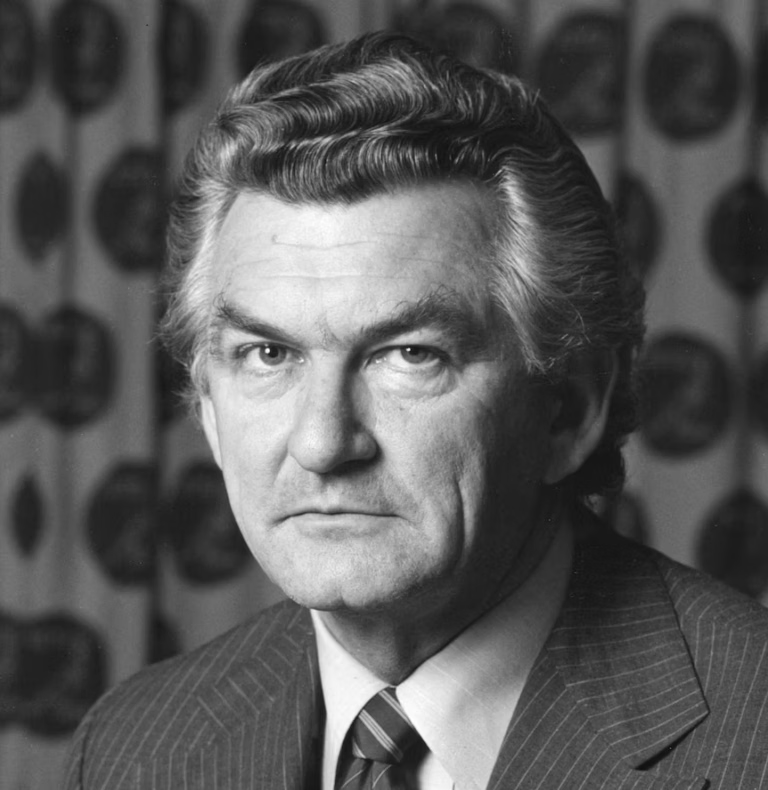
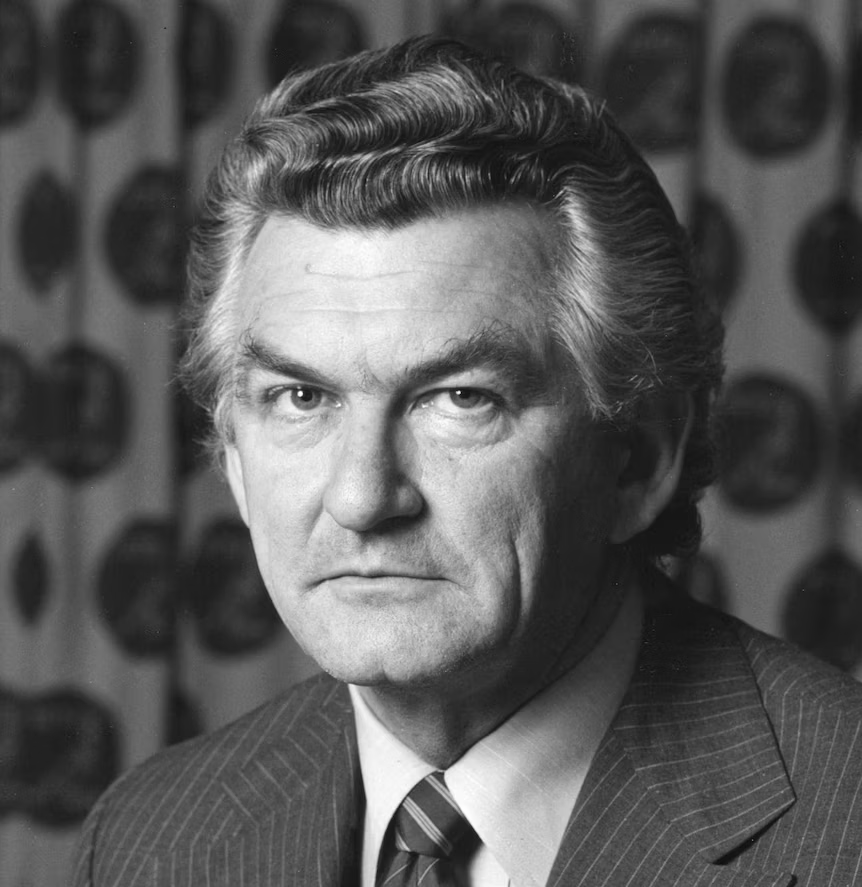
Luckily for Australian capital, the Hawke government provided a solution. In 1983, the Labor Party signed the Prices and Incomes Accord with the ACTU. Unions would moderate wage claims and stop striking in exchange for an increase in the ‘social wage’ in the form of medicare and superannuation. This represented a return to the arbitration system which workers had begun to bypass in the late 60s. In Elizabeth Humphreys’s phrase it was: ‘corporatism within corporatism’.1
The Accord led to re-intensification of the processes already present in arbitration. Union staff became even more distant from the shopfloor, concentrating themselves in the state. To preserve the deal, unions collaborated with bosses in suppressing strikes. Workers either demobilised, losing the memory of how to strike, or left their unions in protest. The Accord led to a temporary increase in the influence of the union bureaucracy but the massive decline in the power and the membership of the unions themselves.
While early stages of the Accord saw a retreat into centralised sectoral arbitration, by its end decentralised Enterprise Bargaining had become increasingly important. To cope with the massive decline in wages, unions began to negotiate EBAs above the Awards, leading the latter to form a ‘safety net’ of minimum conditions. Despite decentralisation, Australia retained key elements of the old system; industrial awards, compulsory dispute resolution, and an umbilical link between the Labor Party and the trade union bureaucracy.2
The Compact
Meanwhile across the ditch the New Zealand Labour Party had embarked on its own solution to the crisis of profitability; Rogernomics. Named for finance minister Roger Douglas, neoliberal reforms in Aotearoa were so severe that they have been described as ‘Chile without the gun’. Trade Unions, who might ordinarily have resisted these policies had they been proposed by a right-wing government, were left blindsided.
In the midst of this confusion, one faction of the union bureaucracy was greatly inspired by the Accord. If agreement could be reached with the Labour Party then perhaps reform could take a positive direction and even steer the way to socialism. In 1987, the private sector Federation of Labour and public sector Combined State Unions merged to form the New Zealand Council of Trades Unions, led by Ken Douglas, a member of the Brezhnevite Socialist Unity Party. Influenced by the ACTU, the new center was much less democratic and soon embarked on their own version of the Accord, which they called the Compact. But unlike in Australia, New Zealand capital had already decided it wanted to rid itself of organised labour once and for all.
On May 15 1991, Parliament passed the Employment Contracts Act. Overnight, it completely dismantled the system of arbitration, compulsory unionism and the sectoral awards that it supported. This meant that unions could no longer represent workers on the basis of an entire industry and would have to negotiate with each individual employer. It made agreements with multiple employers almost impossible and individualised all contracts, making workers ‘free’ to choose who could bargain on their behalf. Similar reforms have been proposed in Australia. Kennet’s Employment Relations Act and Howard’s Work Choices would later be partially inspired by the ECA, but were unable to remake the Australian arbitration system in quite the same way.3
The ECA came at a time when unions were increasingly turning to corporatism and this made it much harder to resist. Many workers wanted a General Strike to defeat the bill, but the NZCTU intervened to prevent this. To quote Tony Simpson:
“I went to one of the biggest union meetings I’d been to in my life. 6000 in the Wellington Town Hall, packed to the gunwales, every public servant in Wellington, and they voted unanimously for a general strike. I took that back to the national policy council of the PSA (I was a Wellington councillor at that stage), where we voted to go for the strike. But a senior staff member of the PSA intervened after the vote was taken and said, ‘If you do this, you jeopardise the salary settlement we have just reached with the government.”4
Instead, the passage of the Act was met by an uneven muffled wave of wildcats. 50,000 days were lost to industrial action in the first week after it passed alone.5 Employers destroyed unions through lockouts, casualisation, and offshoring. They learned from and emboldened one another, each time pushing out the limit of what the new law would allow. Between 1991 and 1999 trade union membership dropped from 42.9 percent to 21.7. The failure to call a General Strike led to a split in the FOL which further weakened the relationship between the Labour Party and the unions.
Effects Today
While in Australia the workers’ movement was destroyed by being sucked into a vice-like embrace with the ALP, in Aotearoa the bureaucracy tried to mirror this embrace, only to disarm itself and open itself up to a mortal injury. From the perspective of the ruling class while the strategy might have differed, the long-term effect has been basically the same: the demobilisation of the workers’ movement and the atrophying of the unions.
But there are some key differences. In Australia the union bureaucracy is much more closely connected with its respective Labo(u)r party. While mostly bad in the long-run, this relationship does provide some benefits. There are still awards in Australia and partially as a result wages are 20 to 30 percent higher.6 Unbeknownst to most Australians, New Zealand is effectively part of Australia’s labour market and this means that workers in Aotearoa are making a rational decision when, like net 30,000 did last year, they fly the ditch. It is this colossal imbalance which is behind Labour’s willingness to reintroduce a form of the Award system through Fair Pay Agreements.
In Aotearoa, two thirds of union members are in the public sector. In Australia public sector workers only became the slight majority in 2024. Vast areas of the private sector economy are represented by no trade union. It is not for nothing that Gold Coast CFMEU rallies can feature haka while in Aotearoa the construction sector is almost completely unorganised.
But grass is not always greener. Union density in Aotearoa sits at 18 percent and has been steadily rising since 2018 when rank and file rebellions in the nurses and teacher unions put some life back into the movement.7 This is despite the attempts of a renewed right-wing government to destroy organised labour. This year, the NZCTU has even over-optimistically claimed that ‘the unions are back’.8 It is important to state that this increase has been made possible by a strike wave. Union membership did not recover when in 2002, Labour introduced more progressive legislation, nor was it tangibly affected by FPA reforms. The Ardern government failed to implement FPAs mostly because it was focused on trying to win over the employers who currently believe that they can run their businesses just fine without unions.
In Australia, despite technically more favourable legislation, density has sunk to 12 percent, density growing for the since 2011 to 13 only last year, and decline has been slower but steadier. This is consistent with a mostly static rate of industrial activity.9
Strategic Implications
Current growth could easily be a blip in a greater story of decline. The lesson from the Accord and the ECA is that the bureaucracy tends to nuzzle up to the state, even when it goes against its own long-term interests, but we have already known this for a hundred years.
An earlier generation of syndicalists and revolutionaries might have assumed that once the arbitration system had vanished, the revolutionary potential of the working class would be unleashed. The unfortunate truth is that the arbitration system is in disrepair because the ruling class feels it is no longer necessary. What is much more significant for workers’ struggle is whether or not workers have had the experience of winning through collective action. What sent workers in Aotearoa into a terminal period of defeat was not just the vital blow of the ECA itself, but rather, as in Australia, the experience of dual defeat by employers and the bureaucracy.
The ruling class will in the last instance put into place whatever labour regime it feels is best for it. As anarchists, a tiny militant minority, we have basically no control over this. Instead, what we can do is build the shopfloor organisation which will exist in either system. Whether in Aotearoa we adopt an Australian-ish system of Fair Pay Agreements or the deregulated system of the 1990s, as is the implied direction of the present government, there will be opportunities for militants. It would be ridiculous to directly oppose FPAs given they have the real chance of lifting workers’ wages. However, they do represent a form of trade unionism from above which does not necessarily empower workers to fight for their own interests. FPAs would not necessarily mean a return to ‘hollow’ unionism because they do not require those covered under them to join the union. Likewise, the days of Workchoices are not that far behind us, the Australian ruling class may not yet be done tinkering with the industrial relations system.
The strategy remains the same: organise at the base of the unions for working class power and fight the bureaucracy when necessary.
- For more read: Elizabeth Humphrey, How Labour Built Neoliberalism: Australia’s Accord, the Labour Movement and the Neoliberal Project. ↩︎
- Technically compulsory dispute resolution has also existed in Aotearoa since 2004 but was not used at all until 2019. It remains basically non-enforced. ↩︎
- For more read: Ellen Dannin, Working Free: The Origins and Impact of New Zealand’s Employment Contracts Act. University of Auckland Press, 1997. ↩︎
- Quote by Tony Simpson, ‘The Employment Contracts Act’ in Mary Ellen O’Connor, The State and the Union, An Oral History of the PSA 1984-2012. Steele Roberts, 2013. ↩︎
- Stephen Blumenfeld and Sue Ryall ”Unions and Union Membership in New Zealand: Annual Review for 2008” New Zealand Journal of Employment Relations 35(3,), 2008: pp. 84-96 ↩︎
- ‘Australia’s Minimum Wage Boost WIdens Pay Gap with New Zealand Minimum Pay’ NZ Herald, 3 June 2026 ↩︎
- “Union Membership Return Report 2025.” MBIE, 24 Mar. 2026, ↩︎
- ‘Undercurrents: Are The Unions Back? Public Interest, 25 June 2026. ↩︎
- “Trade Union Membership, August 2024.” Australian Bureau of Statistics. 2024. ↩︎
Cover image is ‘The Mass Meeting of Trade Unionists in Flinders Park, Melbourne’, published in Illustrated Sydney News, 27 September 1890, page 14, obtained from Wikimedia Commons.
Discover more from SE Qld IWW
Subscribe to get the latest posts sent to your email.